
Lithium batteries are regulated as dangerous goods, so shipping anything that contains or comes with one, from phones to power banks to smart sensors, means following specific rules for classification, packing, marking and carrier acceptance. This guide covers retail shipments from the United States, both domestic and international, as of November 2026.
Quick answer
First identify the battery’s chemistry (lithium-ion or lithium metal) and how it ships: alone, packed with equipment or installed in equipment. Then check its size against the small-battery thresholds, apply the right marks and packaging, and confirm your carrier accepts that exact configuration on that service and route. A battery can qualify for an exception and still be refused by a carrier.
Step 1: Classify the battery
Lithium-ion batteries are generally rechargeable; lithium metal batteries generally are not. Classify the actual battery from the manufacturer’s specs, not the product name.
| How it ships | Lithium-ion | Lithium metal | Example |
|---|---|---|---|
| Battery alone | UN3480 (air: PI 965) | UN3090 (air: PI 968) | A power bank or spare battery shipped by itself |
| Packed with equipment | UN3481 (air: PI 966) | UN3091 (air: PI 969) | A device with its battery boxed separately in the same package |
| Contained in equipment | UN3481 (air: PI 967) | UN3091 (air: PI 970) | A phone or speaker with its battery installed |
Get the UN 38.3 test summary for the exact battery model from the manufacturer. It shows the battery type passed the required transport tests. It generally needs to be available, not packed in every parcel, and a Safety Data Sheet is not a substitute.
Step 2: Check the size thresholds
| Chemistry | Per cell | Per battery |
|---|---|---|
| Lithium-ion | 20 Wh or less | 100 Wh or less |
| Lithium metal | 1 g lithium or less | 2 g lithium or less |
These thresholds determine whether the small-battery rules may apply. They are not blanket exemptions. Configuration, quantity, package weight, transport mode and carrier rules still apply. Above the thresholds, the fully regulated pathway applies unless a specific exception covers it.
How to calculate watt-hours: nominal volts × amp-hours. Divide milliamp-hours by 1,000 first. A 3.7 V, 10,000 mAh battery is 3.7 × 10 = 37 Wh. Use the battery’s rating, not the USB output voltage. For lithium metal, get the lithium content from the manufacturer; it is not the battery’s weight.
Example: a 74 Wh power bank is under 100 Wh, but it is still a standalone UN3480 battery. For air, it does not qualify for Section II and must ship under Section IB, if the carrier accepts it.
Step 3: Know the air shipping rules
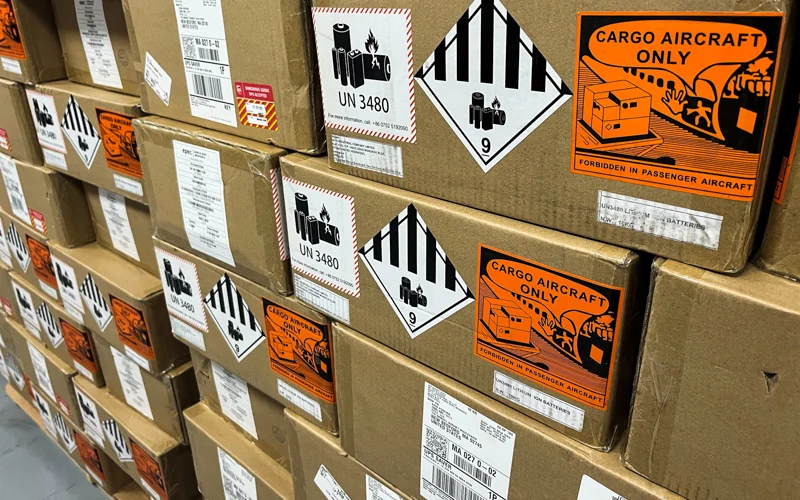
- Lithium-ion shipped alone (UN3480): 30% state of charge or less. Standalone batteries (UN3480 and UN3090) are forbidden on passenger aircraft and must use a cargo-aircraft service.
- Lithium-ion packed with equipment (PI 966): since January 1, 2026, batteries above 2.7 Wh must generally ship at no more than 30% of rated capacity.
- Lithium-ion contained in equipment (PI 967): IATA recommends no more than 30% state of charge or 25% indicated capacity. This is a recommendation, not the same as the PI 966 requirement; check carrier rules.
- Stack test (since January 2025): certain non-UN-specification packages must withstand a 3-meter stack of identical packages for 24 hours. A formal lab test isn’t required, but you must be able to show how you know the package meets it.
Step 4: Apply the right marks and labels
| Item | When it is used |
|---|---|
| Lithium battery mark | On qualifying small-battery packages when the rule requires it, with the UN number. Exceptions can cover button cells installed in equipment, and up to 4 cells or 2 batteries installed in equipment per package (no more than 2 such packages per shipment). Loose spares don’t qualify. |
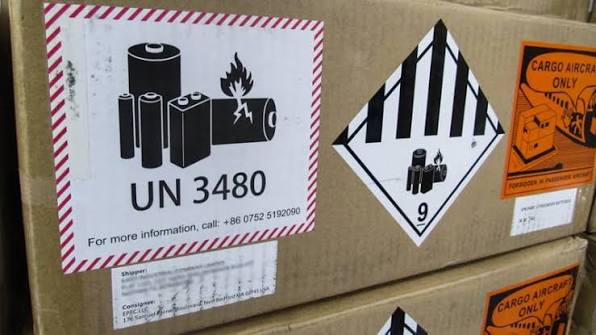
| Class 9 lithium battery label | On fully regulated shipments. For air Section IB standalone batteries, both this label and the battery mark are required. |
| Cargo Aircraft Only label | Where the air packing instruction requires it, including standalone UN3480 and UN3090. |
| Shipping paper or declaration | Fully regulated surface shipments need a hazmat shipping paper. Air Sections I, IA and IB need a Shipper’s Declaration for Dangerous Goods; eligible Section II packages generally don’t. |
Step 5: Pack it correctly
- Prevent short circuits: cover exposed terminals and keep batteries away from metal and each other. Loose batteries need proper inner packaging, not just a carton.
- Prevent movement and activation: secure the battery or device and protect switches that could turn it on in transit. Use strong, rigid outer packaging where required.
- Drop test: under U.S. rules, excepted standalone or packed-with packages must survive a 1.2-meter drop in any orientation without damage. Batteries installed in equipment are excepted from this requirement. Air rules have their own drop and stack requirements.
Step 6: Confirm the carrier accepts it
Check the UN number, packing instruction or exception, destination and tender method before enabling a label.
| Carrier and service | What it generally accepts |
|---|---|
| USPS domestic | Eligible batteries installed in or packed with equipment by air or ground, within USPS limits. Batteries without equipment generally ground only. Used or damaged devices are ground only, with required markings. |
| USPS international and APO/FPO | Batteries must be installed in the equipment. Loose batteries and batteries packed with equipment are prohibited. Usually up to 4 cells or 2 batteries per package. Damaged, defective or recalled batteries are not accepted. |
| UPS Ground | Eligible standalone, packed-with and installed batteries under U.S. ground rules. Fully regulated shipments need a UPS hazmat agreement. |
| UPS Air | Standalone batteries only as fully regulated dangerous goods with a UPS contract; standalone lithium metal also needs preapproval. Eligible packed-with and installed batteries can use Section II where accepted. |
| FedEx Ground | All four UN numbers under U.S. ground rules. Fully regulated Class 9 shipments require shipper preapproval. |
| FedEx Express | Packed-with and installed batteries under the air rules, including Section II where accepted. Standalone batteries are cargo-aircraft only under the fully regulated pathway. |
| DHL Express (international) | Requires account approval, with acceptance by configuration and lane. Does not accept known or suspected unsafe batteries. Maximum 2 batteries per package. |
The most common dead ends: standalone batteries booked as passenger-aircraft cargo, loose or packed-with batteries sent by USPS international mail, and unsafe batteries sent through regular parcel services.
Training requirements
- U.S. DOT: where full hazmat training applies, employees must be trained, tested and certified for their tasks within 90 days of hire, with recurrent training at least every three years. Until then, they work under direct supervision.
- Air: fully regulated air shipping requires competency-based training under the IATA Dangerous Goods Regulations, renewed within 24 months. Some Section II provisions only require “adequate instruction.”
- Employee training, a carrier agreement and a battery’s UN 38.3 test summary are three separate things. Having one does not cover the others.
Damaged, defective or recalled batteries
If a battery is swollen, leaking, damaged or recalled for a safety defect, stop normal fulfillment and returns. Under U.S. rules, these batteries can only move by highway, rail or vessel, never by air, with special packaging and a “Damaged/defective lithium ion battery” or “lithium metal battery” marking. Carriers are often stricter: UPS only accepts them through a specialized service with preapproval, and USPS and DHL Express are not options. Never issue a regular prepaid return label for a battery that may be unsafe. Use a trained specialist.
How common products are classified
| Product as shipped | Usual classification |
|---|---|
| New phone, Bluetooth speaker or smart device with its battery installed | UN3481, contained in equipment |
| Smart sensor or tracker with an installed coin cell | UN3091, contained in equipment (an installed button cell may qualify for a marking exception) |
| Power bank or spare rechargeable battery on its own | UN3480, even with ports, a display or a protective case |
| Replacement e-bike battery on its own | UN3480; check the Wh rating, as it often exceeds 100 Wh |
| Complete e-bike | UN3556 (lithium-ion battery-powered vehicle) under IATA rules, not a battery or ordinary equipment |
Questions to ask your 3PL
- “Can you show the UN number, configuration, exception or packing instruction, and quantity limit for each SKU and packout?”
- “Which services and destinations are approved on your account, and does your system block orders outside those approvals?”
- “Who approves the packout, verifies drop or stack requirements, and checks marks, labels and paperwork before shipping?”
- “How do you screen returns for swelling, damage and recalls before issuing a label?”
- “Who maintains test summaries and training records, signs declarations, and updates rules when carrier policies change?”
Related: How to ship perfume internationally, another common dangerous goods shipment.
Frequently asked questions
Are lithium batteries under 100 Wh unregulated?
No. 100 Wh is the threshold for the small-battery rules, which still have requirements for marking, packaging, quantity and carrier acceptance.
Can you ship lithium batteries through USPS?
Domestically, yes, within USPS limits: installed or packed-with batteries can go by air or ground, and batteries without equipment generally go by ground only. Internationally, batteries must be installed in the equipment.
Can you ship a power bank by air?
Only as a standalone UN3480 battery on a cargo-aircraft service that accepts it, at 30% charge or less. Standalone batteries are forbidden on passenger aircraft.
How do I calculate a battery’s watt-hours?
Multiply nominal volts by amp-hours. For a 3.7 V, 10,000 mAh battery: 3.7 × 10 = 37 Wh.
Can customers return a swollen or damaged battery with a regular label?
No. Damaged or defective batteries cannot travel by air and need special packaging and handling. Arrange transport through a trained specialist.
Dangerous goods rules and carrier policies change regularly. This guide reflects rules as of November 2026; confirm requirements with your carrier before shipping a new product or using a new service.