Category: Shipping

  • How to Ship Lithium Batteries: A Guide for Ecommerce Brands

    How to Ship Lithium Batteries: A Guide for Ecommerce Brands

    Lithium batteries are regulated as dangerous goods, so shipping anything that contains or comes with one, from phones to power banks to smart sensors, means following specific rules for classification, packing, marking and carrier acceptance. This guide covers retail shipments from the United States, both domestic and international, as of November 2026.

    Quick answer

    First identify the battery’s chemistry (lithium-ion or lithium metal) and how it ships: alone, packed with equipment or installed in equipment. Then check its size against the small-battery thresholds, apply the right marks and packaging, and confirm your carrier accepts that exact configuration on that service and route. A battery can qualify for an exception and still be refused by a carrier.

    Step 1: Classify the battery

    Lithium-ion batteries are generally rechargeable; lithium metal batteries generally are not. Classify the actual battery from the manufacturer’s specs, not the product name.

    How it shipsLithium-ionLithium metalExample
    Battery aloneUN3480 (air: PI 965)UN3090 (air: PI 968)A power bank or spare battery shipped by itself
    Packed with equipmentUN3481 (air: PI 966)UN3091 (air: PI 969)A device with its battery boxed separately in the same package
    Contained in equipmentUN3481 (air: PI 967)UN3091 (air: PI 970)A phone or speaker with its battery installed

    Get the UN 38.3 test summary for the exact battery model from the manufacturer. It shows the battery type passed the required transport tests. It generally needs to be available, not packed in every parcel, and a Safety Data Sheet is not a substitute.
    Step 2: Check the size thresholds

    ChemistryPer cellPer battery
    Lithium-ion20 Wh or less100 Wh or less
    Lithium metal1 g lithium or less2 g lithium or less

    These thresholds determine whether the small-battery rules may apply. They are not blanket exemptions. Configuration, quantity, package weight, transport mode and carrier rules still apply. Above the thresholds, the fully regulated pathway applies unless a specific exception covers it.

    How to calculate watt-hours: nominal volts × amp-hours. Divide milliamp-hours by 1,000 first. A 3.7 V, 10,000 mAh battery is 3.7 × 10 = 37 Wh. Use the battery’s rating, not the USB output voltage. For lithium metal, get the lithium content from the manufacturer; it is not the battery’s weight.

    Example: a 74 Wh power bank is under 100 Wh, but it is still a standalone UN3480 battery. For air, it does not qualify for Section II and must ship under Section IB, if the carrier accepts it.

    Step 3: Know the air shipping rules

    • Lithium-ion shipped alone (UN3480): 30% state of charge or less. Standalone batteries (UN3480 and UN3090) are forbidden on passenger aircraft and must use a cargo-aircraft service.
    • Lithium-ion packed with equipment (PI 966): since January 1, 2026, batteries above 2.7 Wh must generally ship at no more than 30% of rated capacity.
    • Lithium-ion contained in equipment (PI 967): IATA recommends no more than 30% state of charge or 25% indicated capacity. This is a recommendation, not the same as the PI 966 requirement; check carrier rules.
    • Stack test (since January 2025): certain non-UN-specification packages must withstand a 3-meter stack of identical packages for 24 hours. A formal lab test isn’t required, but you must be able to show how you know the package meets it.

    Step 4: Apply the right marks and labels

    ItemWhen it is used
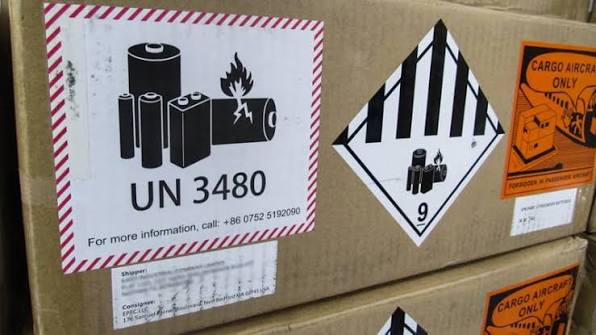
    Lithium battery markOn qualifying small-battery packages when the rule requires it, with the UN number. Exceptions can cover button cells installed in equipment, and up to 4 cells or 2 batteries installed in equipment per package (no more than 2 such packages per shipment). Loose spares don’t qualify.
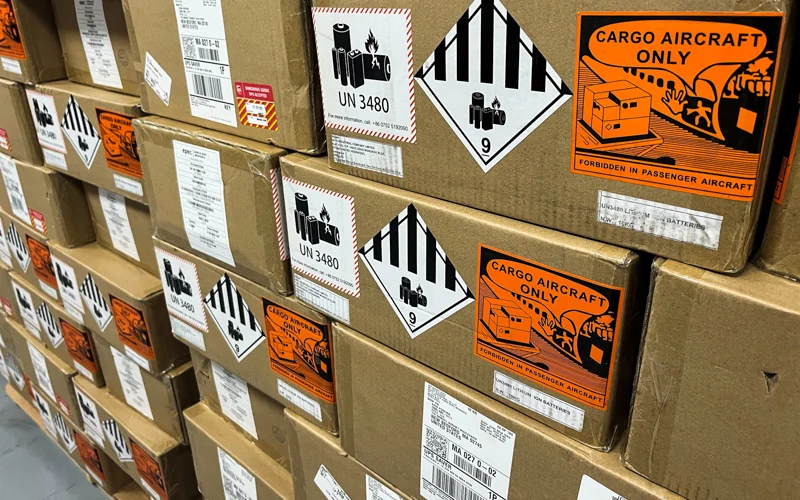
    Class 9 lithium battery labelOn fully regulated shipments. For air Section IB standalone batteries, both this label and the battery mark are required.
    Cargo Aircraft Only labelWhere the air packing instruction requires it, including standalone UN3480 and UN3090.
    Shipping paper or declarationFully regulated surface shipments need a hazmat shipping paper. Air Sections I, IA and IB need a Shipper’s Declaration for Dangerous Goods; eligible Section II packages generally don’t.

    Step 5: Pack it correctly

    • Prevent short circuits: cover exposed terminals and keep batteries away from metal and each other. Loose batteries need proper inner packaging, not just a carton.
    • Prevent movement and activation: secure the battery or device and protect switches that could turn it on in transit. Use strong, rigid outer packaging where required.
    • Drop test: under U.S. rules, excepted standalone or packed-with packages must survive a 1.2-meter drop in any orientation without damage. Batteries installed in equipment are excepted from this requirement. Air rules have their own drop and stack requirements.

    Step 6: Confirm the carrier accepts it

    Check the UN number, packing instruction or exception, destination and tender method before enabling a label.

    Carrier and serviceWhat it generally accepts
    USPS domesticEligible batteries installed in or packed with equipment by air or ground, within USPS limits. Batteries without equipment generally ground only. Used or damaged devices are ground only, with required markings.
    USPS international and APO/FPOBatteries must be installed in the equipment. Loose batteries and batteries packed with equipment are prohibited. Usually up to 4 cells or 2 batteries per package. Damaged, defective or recalled batteries are not accepted.
    UPS GroundEligible standalone, packed-with and installed batteries under U.S. ground rules. Fully regulated shipments need a UPS hazmat agreement.
    UPS AirStandalone batteries only as fully regulated dangerous goods with a UPS contract; standalone lithium metal also needs preapproval. Eligible packed-with and installed batteries can use Section II where accepted.
    FedEx GroundAll four UN numbers under U.S. ground rules. Fully regulated Class 9 shipments require shipper preapproval.
    FedEx ExpressPacked-with and installed batteries under the air rules, including Section II where accepted. Standalone batteries are cargo-aircraft only under the fully regulated pathway.
    DHL Express (international)Requires account approval, with acceptance by configuration and lane. Does not accept known or suspected unsafe batteries. Maximum 2 batteries per package.

    The most common dead ends: standalone batteries booked as passenger-aircraft cargo, loose or packed-with batteries sent by USPS international mail, and unsafe batteries sent through regular parcel services.

    Training requirements

    • U.S. DOT: where full hazmat training applies, employees must be trained, tested and certified for their tasks within 90 days of hire, with recurrent training at least every three years. Until then, they work under direct supervision.
    • Air: fully regulated air shipping requires competency-based training under the IATA Dangerous Goods Regulations, renewed within 24 months. Some Section II provisions only require “adequate instruction.”
    • Employee training, a carrier agreement and a battery’s UN 38.3 test summary are three separate things. Having one does not cover the others.

    Damaged, defective or recalled batteries

    If a battery is swollen, leaking, damaged or recalled for a safety defect, stop normal fulfillment and returns. Under U.S. rules, these batteries can only move by highway, rail or vessel, never by air, with special packaging and a “Damaged/defective lithium ion battery” or “lithium metal battery” marking. Carriers are often stricter: UPS only accepts them through a specialized service with preapproval, and USPS and DHL Express are not options. Never issue a regular prepaid return label for a battery that may be unsafe. Use a trained specialist.

    How common products are classified

    Product as shippedUsual classification
    New phone, Bluetooth speaker or smart device with its battery installedUN3481, contained in equipment
    Smart sensor or tracker with an installed coin cellUN3091, contained in equipment (an installed button cell may qualify for a marking exception)
    Power bank or spare rechargeable battery on its ownUN3480, even with ports, a display or a protective case
    Replacement e-bike battery on its ownUN3480; check the Wh rating, as it often exceeds 100 Wh
    Complete e-bikeUN3556 (lithium-ion battery-powered vehicle) under IATA rules, not a battery or ordinary equipment

    Questions to ask your 3PL

    • “Can you show the UN number, configuration, exception or packing instruction, and quantity limit for each SKU and packout?”
    • “Which services and destinations are approved on your account, and does your system block orders outside those approvals?”
    • “Who approves the packout, verifies drop or stack requirements, and checks marks, labels and paperwork before shipping?”
    • “How do you screen returns for swelling, damage and recalls before issuing a label?”
    • “Who maintains test summaries and training records, signs declarations, and updates rules when carrier policies change?”

    Related: How to ship perfume internationally, another common dangerous goods shipment.

    Frequently asked questions

    Are lithium batteries under 100 Wh unregulated?

    No. 100 Wh is the threshold for the small-battery rules, which still have requirements for marking, packaging, quantity and carrier acceptance.

    Can you ship lithium batteries through USPS?

    Domestically, yes, within USPS limits: installed or packed-with batteries can go by air or ground, and batteries without equipment generally go by ground only. Internationally, batteries must be installed in the equipment.

    Can you ship a power bank by air?

    Only as a standalone UN3480 battery on a cargo-aircraft service that accepts it, at 30% charge or less. Standalone batteries are forbidden on passenger aircraft.

    How do I calculate a battery’s watt-hours?

    Multiply nominal volts by amp-hours. For a 3.7 V, 10,000 mAh battery: 3.7 × 10 = 37 Wh.

    Can customers return a swollen or damaged battery with a regular label?

    No. Damaged or defective batteries cannot travel by air and need special packaging and handling. Arrange transport through a trained specialist.

    Dangerous goods rules and carrier policies change regularly. This guide reflects rules as of November 2026; confirm requirements with your carrier before shipping a new product or using a new service.

  • How to Ship Perfume Internationally from the US

    How to Ship Perfume Internationally from the US

    Shipping perfume internationally is regulated because most perfumes contain alcohol, which makes them a flammable liquid under transport rules. It can be done, but only through the right carrier service and with the right paperwork. This guide covers commercial shipments that start in the United States.

    Quick answer

    Alcohol-based perfume can ship internationally on an approved dangerous goods service, when the carrier accepts the exact product, packaging and destination. USPS does not allow alcohol-containing perfume in international mail, UPS Ground Saver is domestic only, and a commercial invoice does not replace dangerous goods paperwork.

    Which carriers and services you can use

    • USPS: prohibits alcohol-containing perfume in international mail.
    • UPS: requires a signed agreement for its U.S.-origin International Dangerous Goods service, and only accepts approved commodities to approved destinations.
    • DHL Express: describes a preapproval process for dangerous goods perfume shipments.
    • UPS Ground Saver: not an international service. (See UPS Ground vs. Ground Saver.)

    A domestic ground exception does not make a product eligible for international air. Treat international shipments as a separate approval.

    How to ship perfume internationally, step by step

    Step 1: Get the Safety Data Sheet and verify the classification

    Request the current Safety Data Sheet (SDS) for the exact SKU from the manufacturer or supplier. Have a trained dangerous goods shipper verify the flash point and transport classification for the way it will travel. Alcohol-based perfume commonly falls under Class 3, flammable liquids. Record the verified classification in the SKU record.

    Step 2: Confirm the carrier will accept it

    Before booking, give the carrier the origin, destination, verified classification, bottle volume, units per carton and total quantity. Ask:

    • Which service and packing instruction apply?
    • Is a limited quantity provision available?
    • How should the package be tendered?

    Step 3: Check the destination’s import rules

    Carrier acceptance does not mean the product can clear customs. Have the carrier or a customs broker confirm that the destination allows the commercial import and whether any permits, cosmetics documentation or labeling are required. Agree up front on who handles import clearance and who pays duties and taxes.

    Step 4: Pack and label to the packing instruction

    Check the quantity limits per inner container and per outer package, the packaging specifications, and the required marks and labels. Secure the closures and protect bottles from breaking or moving. Add absorbent material, secondary containment, orientation arrows or hazard labels where the instruction requires them. There is no universal bottle limit or label set, so always work from the instruction that applies to your shipment.

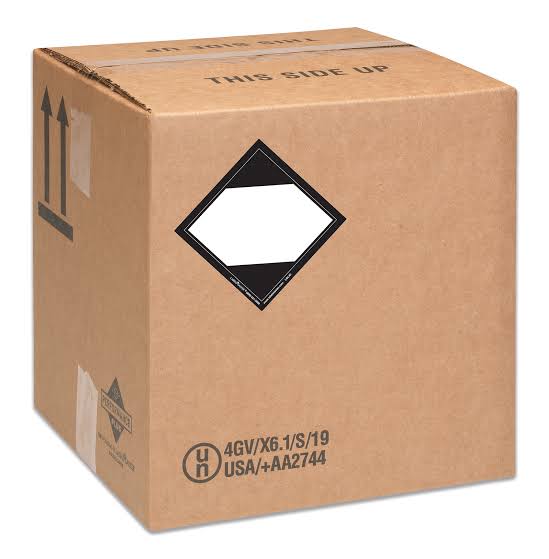
    A limited quantity mark on a domestic ground perfume shipment. International shipments follow the marks and labels required by the carrier’s dangerous goods packing instruction.

    Step 5: Prepare the documents and hand it over

    Complete the customs documents and the dangerous goods documents separately. For UPS shipments that need a dangerous goods declaration, follow UPS’s requirements for software, format, copies and multi-piece shipments. Before release, check that the SKU, quantities, package markings, invoice and declaration all match, then tender the package the way the carrier approved.

    Documentation checklist

    DocumentWhat it is forWhat to know
    Safety Data Sheet (SDS)Supports classification and carrier reviewKeep the current sheet for the exact formulation. It does not replace a shipping declaration.
    Commercial invoiceCustoms clearance and valuationInclude an accurate description, quantity, value and currency, country of origin, tariff classification, shipper and consignee, and delivery terms.
    Carrier label or air waybillIdentifies and routes the shipmentMust include the dangerous goods information the carrier’s system requires. A parcel label alone does not clear dangerous goods.
    Shipper’s Declaration for Dangerous GoodsRequired for air shipments when applicableUses the verified description, hazard class, packing group, package count and type, quantity and packing instruction.
    Electronic Export Information (EEI)Export filing through AES, if requiredRequired when value exceeds $2,500 under a single Schedule B number (unless exempt), or when filing is mandatory regardless of value.
    Destination-specific documentsImport requirementsMay include proof of origin, an import permit or importer documents. Confirm with your broker before shipping.

    Describe the product clearly on the invoice. “Alcohol-based eau de parfum, 50 mL retail bottles” works. “Beauty products” does not.

    How the EEI threshold works: $2,600 under one Schedule B number can trigger filing. $2,600 split across two classifications at $1,300 each does not trigger filing on value alone.

    Common mistakes to avoid

    • Copying the UN number or packing group from a different fragrance.
    • Assuming an alcohol-free perfume is unregulated without checking.
    • Assuming sample bottles are automatically exempt.
    • Treating the commercial invoice as the dangerous goods paperwork.
    • Assuming that because a carrier accepted the package, it will clear customs at the destination.

    The question to ask your 3PL

    If a 3PL ships perfume for you, ask: “Can you approve this exact perfume SKU, packaging configuration and destination under your dangerous goods carrier agreement, and who prepares and signs the paperwork?” Being able to print an international label is not the same as being able to ship a regulated product.

    For how domestic perfume orders are handled, see perfume and fragrance fulfillment.

    Frequently asked questions

    Can you ship perfume internationally through USPS?

    No. USPS prohibits alcohol-containing perfume in international mail.

    Is perfume considered a dangerous good?

    Alcohol-based perfume commonly falls under Class 3, flammable liquids. Verify the classification for each SKU using its Safety Data Sheet.

    Can UPS ship perfume internationally?

    Yes, through UPS’s International Dangerous Goods service, which requires a signed agreement and only covers approved commodities and destinations.

    Are perfume samples exempt from dangerous goods rules?

    Not automatically. Samples need to be verified like any other SKU.

    Is a commercial invoice enough to ship perfume abroad?

    No. The commercial invoice is for customs. Dangerous goods documents, such as the Shipper’s Declaration for air, are separate.

    Dangerous goods and customs rules change and vary by carrier and destination. Confirm requirements with your carrier and customs broker before every new SKU or destination.

  • UPS Ground vs. UPS Ground Saver: Which Should You Use?

    UPS Ground vs. UPS Ground Saver: Which Should You Use?

    UPS Ground and UPS Ground Saver are both ground services, but they differ in speed, who delivers the package, which addresses they serve and how claims work. Here is what changes and how to pick the right one for each order.

    Quick answer

    Use UPS Ground Saver for less urgent residential orders when it is enabled on your account, the address qualifies and the delivery estimate still meets your promise. Use UPS Ground when you need the faster estimate, a commercial delivery, or UPS handling the package all the way to the door.

    UPS Ground vs. Ground Saver at a glance

    UPS GroundUPS Ground Saver
    Transit time1 to 5 business days (domestic)Usually about 1 to 2 business days longer than Ground
    Final deliveryUPS, from pickup to deliveryUPS or USPS
    TrackingUPS tracking numberUPS tracking number; delivery photo only when UPS delivers
    Addresses servedEligible street addresses, including commercialEligible residential addresses, plus PO Boxes and APO/FPO/DPO
    Coverage areaDomestic Ground serviceShips from the contiguous 48 states to the contiguous states, Alaska, Hawaii, Puerto Rico and U.S. territories
    InternationalNo (domestic service)No
    ClaimsStandard Ground termsUp to $50 per package, subject to UPS terms; no claims after the USPS handoff scan
    PriceStandard Ground ratesPositioned as lower cost; actual savings depend on your account rates
    AccountStandardRequires an eligible UPS contract

    The key differences

    1. Speed

    UPS publishes 1 to 5 business days for domestic Ground. Ground Saver generally takes about 1 to 2 business days longer. Always go by the estimate for the specific shipment rather than treating either range as a guarantee.

    2. Who delivers the package

    With Ground, UPS handles the package from pickup to delivery. With Ground Saver, UPS or USPS may make the final delivery. The package keeps a UPS tracking number either way, but delivery photo confirmation is only available when UPS is the one delivering it.

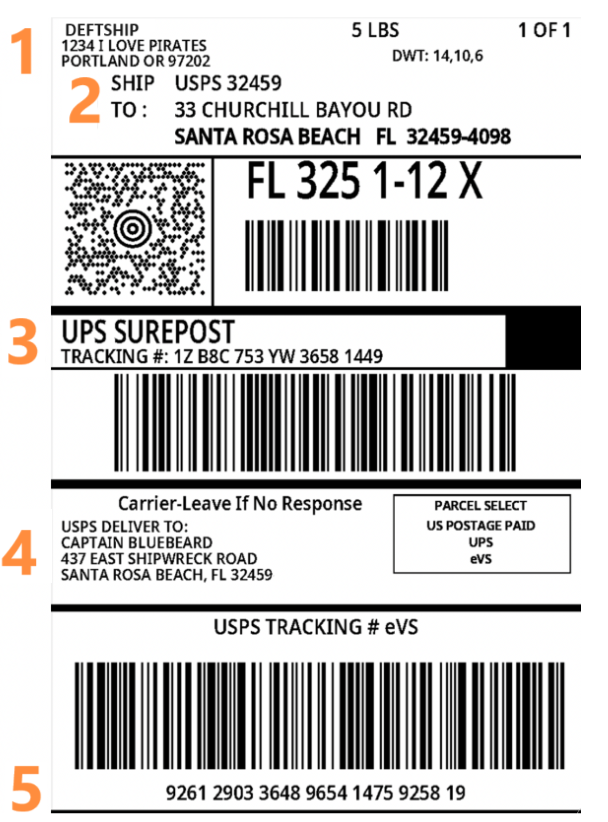
    A Ground Saver label (shown under its former SurePost name) carries a UPS tracking number plus a USPS barcode for the final delivery.

    3. Which addresses qualify

    Ground serves eligible street addresses, including businesses. Ground Saver is built for residential delivery and also covers eligible PO Boxes and military APO/FPO/DPO addresses, which standard Ground does not. Neither one ships internationally.

    4. Claims

    UPS advertises up to $50 per Ground Saver package, subject to its terms. UPS no longer accepts a Ground Saver claim once the scan showing the handoff to USPS is recorded, so that $50 is not coverage all the way to the door. The Saver limit does not apply to standard Ground.

    5. Price

    Ground Saver is positioned as the cheaper option, but there is no fixed savings percentage. The only reliable comparison is your own account rates for the same origin, destination, ship date, packed weight and dimensions, including surcharges and discounts.

    How to choose for each order

    1. Check eligibility. Confirm Ground Saver is enabled on your account and that the address and packed parcel meet its current terms. Do not assume Ground’s size and weight limits apply to Saver.
    2. Compare the real numbers. Look at the total price and the estimated delivery date for the same shipment on both services.
    3. Pick Ground Saver when the order qualifies, the estimate meets your delivery promise, and you are fine with a possible USPS handoff and its claims terms.
    4. Pick Ground when Saver misses the delivery window, the address is commercial, or UPS handling through final delivery matters for that order.
    5. PO Box or military address? Check Ground Saver eligibility. Standard Ground is not a fallback for these addresses.

    Frequently asked questions

    Is UPS Ground Saver the same as UPS SurePost?

    Yes. UPS Ground Saver is the current name for the service formerly called UPS SurePost.

    Does USPS deliver UPS Ground Saver packages?

    Sometimes. UPS or USPS may make the final delivery. You still track the package with its UPS tracking number.

    Is UPS Ground Saver cheaper than UPS Ground?

    It is positioned as the lower-cost option, but savings vary. Compare your account’s actual rates for the same package and destination.

    Can UPS Ground Saver deliver to PO Boxes?

    Yes, to eligible U.S. PO Boxes and APO/FPO/DPO addresses. Standard UPS Ground does not deliver to these.

    Can I use UPS Ground Saver for international shipments?

    No. Ground Saver only serves U.S. destinations, including Alaska, Hawaii, Puerto Rico and U.S. territories.

    How much is a UPS Ground Saver package covered for?

    UPS advertises up to $50 per package, subject to its terms, and does not accept a claim once the USPS handoff scan is recorded.

    Carrier services and terms change. Check UPS’s current service guide and your account settings before making Ground Saver your default.

  • 7 reasons Why Ecommerce Brands Choose a 3PL in Newark or Elizabeth, NJ

    7 reasons Why Ecommerce Brands Choose a 3PL in Newark or Elizabeth, NJ

    A 3PL in Newark or Elizabeth, New Jersey puts your inventory minutes from the busiest port on the East Coast, a few miles from Newark Liberty Airport, and within 1 to 2 days by ground of most of the Northeast. For brands that import products or sell heavily to customers between Boston and Washington DC, it’s one of the most cost-effective places in the country to fulfill orders.

    Here are the seven biggest advantages of using a 3PL in Newark or Elizabeth, NJ, the trade-offs to know, and what to ask before you choose one.

    1. You’re next to the busiest port on the East Coast

    The Port of New York and New Jersey moved about 8.9 million TEUs (twenty-foot container equivalents) in 2025 and finished the year as the second-busiest U.S. port for loaded containers, according to Container News.

    Its largest terminal complex, Port Newark–Elizabeth Marine Terminal, sits directly between the two cities. A warehouse in Newark or Elizabeth is often only a few miles, and 10 to 20 minutes, from where containers come off the ship. A warehouse in central or southern New Jersey or eastern Pennsylvania can be an hour or more away.

    2. Short trips mean lower drayage costs

    Drayage is the trucking that moves a container from the port to a warehouse and returns the empty container afterward. Three things drive the cost:

    • Distance and time. Drayage carriers price by the trip. A 10-minute run costs less than a 90-minute one, and a driver can often complete more trips per day.
    • Chassis rental. The trailer a container sits on is rented by the day. A container that’s unloaded and returned the same day or next day costs less in chassis fees.
    • Demurrage and detention. Ports charge demurrage when a container sits at the terminal too long, and carriers charge detention when an empty container isn’t returned on time. Short trips and quick unloading make both less likely.

    If you import even a few containers a year, these costs can outweigh small differences in pick and pack rates between 3PLs.

    3. Inventory gets on the shelf faster

    The faster a container goes from vessel to warehouse, the sooner your products are available to sell. Being close to the port matters most for:

    • Restocks of best-sellers that are out of stock and losing sales every day
    • Product launches tied to a fixed date
    • Q4 peak season, when ports and highways are congested and every day of delay costs more

    4. 1–2 day ground shipping to the whole Northeast

    According to the New Jersey Economic Development Authority, about 40% of U.S. consumers live within a one-day drive of New Jersey.

    From Newark and Elizabeth, with direct access to I-95, the New Jersey Turnpike, I-78 and the Garden State Parkway, ground shipping reaches customers from Maine to Virginia in 1 to 2 days. That includes New York City, Philadelphia, Boston, Baltimore and Washington DC.

    Ground shipping to nearby zones costs far less than expedited air, and faster delivery tends to mean fewer “where’s my order?” tickets, better reviews and more repeat customers.

    5. Newark Liberty Airport is next door

    Newark Liberty International Airport (EWR) borders both cities. For ecommerce brands, that brings two advantages:

    • Air freight. Urgent restocks, samples and smaller international shipments can arrive by air and reach the warehouse within hours.
    • Carrier networks. UPS, FedEx and USPS operate major facilities around Newark, which often means later daily pickups and faster handoffs into the carrier network than from more remote warehouses.

    6. New York City is a short drive away

    New York City is one of the largest and wealthiest consumer markets in the world, and it’s about 10 to 15 miles from Newark and Elizabeth.

    That proximity matters most for brands selling wholesale to NYC retailers. Local B2B deliveries can be made by box truck or van in a few hours, rather than booked as LTL freight that can take days. When you compare 3PLs, ask whether they offer local delivery or only parcel and LTL shipping.

    7. The whole import ecosystem is nearby

    Customs brokers, freight forwarders, drayage carriers, bonded warehouses and rail terminals are concentrated around the port. Rail is growing too: container rail volume at the port rose more than 12% in 2025.

    For importers, that means fewer handoffs between partners spread across the region, and it’s easier to coordinate customs clearance, drayage, unloading and fulfillment as one process.

    What are the trade-offs?

    No location is perfect. Before choosing a 3PL in Newark or Elizabeth, NJ, consider:

    • Higher storage costs. Warehouse space near New York City costs more than in rural areas, so pallet storage often runs above the national average. Compare total cost per order, not just the storage rate. We explain how in our 3PL cost breakdown for New Jersey.
    • Traffic and congestion. Roads around the port are busy, especially at peak hours and during peak season. A good local 3PL schedules drayage and pickups around it.
    • West Coast customers. If most of your customers are in California or the Pacific Northwest, a single East Coast warehouse means slower, more expensive shipping to them. Many brands solve this with one warehouse on each coast.

    Who is a Newark or Elizabeth 3PL best for?

    A 3PL in Newark or Elizabeth, NJ is a strong fit if you:

    • Import products in containers through the Port of NY/NJ
    • Sell mostly to the Northeast or East Coast, from Boston to DC
    • Sell wholesale to NYC retailers
    • Sell on Amazon and want inventory prepped close to where it lands, instead of after a long inland trip
    • Want fast delivery to the most densely populated region in the country

    Questions to ask a 3PL near the port

    Not every warehouse in the area takes full advantage of its location. Before signing, ask:

    1. How far is your warehouse from Port Newark–Elizabeth, in miles and in typical drive time?
    2. Do you arrange drayage, or do I need my own carrier? If they arrange it, ask for an all-in price per container, including chassis days.
    3. How fast do you unload a container after it arrives? Ask for a typical turnaround in hours or days, not “as soon as possible.”
    4. How do you charge for container unloading? Floor-loaded and palletized containers are priced differently, and so are high carton counts.
    5. What’s your daily order cutoff for same-day shipping?
    6. Which carriers pick up from you, and at what time?
    7. Do you offer local delivery to NYC and New Jersey, or only parcel and LTL?
    8. Do you work with customs brokers you can recommend?

    The answers will tell you quickly whether a 3PL’s location actually saves you money or just sounds good on a map.

    Frequently asked questions

    Why do so many 3PLs operate in Newark and Elizabeth, NJ? Both cities border the Port of New York and New Jersey, the busiest container port on the East Coast, and Newark Liberty Airport, with direct access to I-95 and the New Jersey Turnpike. That makes it easy to receive imports and ship quickly across the Northeast.

    How far is Elizabeth, NJ from Port Newark? Elizabeth borders the Port Newark–Elizabeth Marine Terminal. Many warehouses in Elizabeth are within about 5 miles and 10 minutes of the port.

    How fast can a New Jersey 3PL ship to customers? From Newark or Elizabeth, ground shipping reaches most of the Northeast, from Maine to Virginia, in 1 to 2 days, including New York City, Philadelphia, Boston, Baltimore and Washington DC.

    Is a 3PL near the port cheaper? Often, for brands that import. Short drayage trips cost less, containers are returned faster, and demurrage and detention fees are less likely. Storage near NYC can cost more, so compare total cost per order.

    What is drayage? Drayage is short-distance trucking that moves a shipping container from the port to a nearby warehouse or rail yard, and returns the empty container afterward.


    Importing through the Port of NY/NJ or shipping to the Northeast? Get a custom fulfillment quote →